Nearly half of US adults under 65 had little to no health insurance in 2026: Report
Almost half (46%) of working-age adults aged 19 to 64 had inadequate health insurance this year, according to a report from The Commonwealth Fund. Published Oct. 22, “The State of Health Insurance Coverage in 2026” was based on the fund’s 2026 Biennial Health Insurance Survey.
Among those adults, 11% were uninsured, 12% had a coverage gap this year, and 23% were underinsured, meaning they had coverage that did not provide access to affordable care, the report showed. Starting last year and continuing now, Affordable Care Act (ACA) marketplace coverage declined, as did enrollment in the individual insurance market, the report noted. Also, Medicaid coverage rates fell, a drop that began after 2022, the report added.
In addition, the report showed a drop in coverage among young adults, 19 to 34, under the ACA and Medicaid and among those the survey classified as low-income working-age adults with a household income under 200% of the federal poverty level. The 200% level equals $31,300 in annual income for an individual and $64,300 for a family of four, the report noted.
‘Really substantial losses’
“The coverage losses that have already happened in the marketplaces are really substantial,” Sara R. Collins, Ph.D., said in a telephone interview. Collins is an economist and senior scholar for the Expanding Coverage and Access and Tracking Health System Performance programs at the Commonwealth Fund.
In the coming months, more Americans will lose their ACA health insurance and millions more are likely to lose their Medicaid coverage this year and next, she said. Among Medicaid members, the coverage losses will be substantial as states implement new work requirements that Congress included in the July 2025 budget reconciliation bill , Collins predicted. For details, see this KFF report: “Tracking Implementation of the 2025 Reconciliation Law: Medicaid Work Requirements.”
“I think we’re going to see major losses as people run up against administrative barriers, and those losses will vary a lot by state,” she said. “Some states that have the resources will put a lot of effort behind trying to keep people enrolled. But other states won’t have as much in terms of resources to keep people covered.”
To put these health insurance losses in perspective, the report noted that enrollment rose after Congress passed the ACA (also called Obamacare) in 2010. “Between 2010 and 2025, the U.S. uninsured rate fell by half, from nearly 16% to 8%, largely as a result of the ACA and expanded premium subsidies for marketplace plans,” The Commonwealth Fund’s Oct. 22 report showed.
37 million could lose health insurance
But the deep cuts in funding for Medicaid and the ACA marketplaces that the Trump administration and Congress made in 2025 will cause even more Americans to lose their health insurance, the report showed. Those changes are expected to drive the number of uninsured people to 37 million by 2036 — about the same rate as in 2014, the report noted.
When the tax credits expired, ACA premium costs rose sharply for many enrollees, particularly those with annual income above 400% of the federal poverty level (FPL) who had become eligible for subsidies under the enhanced credits, KFF reported in May. For a single person, 400% of is annual income of $15,960, and for a family of four, $33,000.
Other Trump administration policy changes also cut enrollment, such as the more than 750,000 enrollees who were ejected from the ACA marketplaces in September. At the time, the federal Centers for Medicare and Medicaid Services announced that it canceled about 315,000 unauthorized enrollments covering more than 760,000 individuals, saving roughly $2.2 billion in taxpayer-funded subsidies, the agency said.
Some of those consumers were not real people, and many were unqualified for premium subsidies, Vice President JD Vance claimed, according to reporting from Margot Sanger-Katz, Sarah Kliff and Christopher Rowland in The New York Times.
Drop in coverage varies by state
Journalists covering this story will find that after the federal government failed to extend the enhanced premium tax credits past 2025, Affordable Care Act members dropped out in every state except New Mexico. The state was an outlier because BeWell, New Mexico’s Affordable Care Act exchange marketplace, enrolled 82,407 residents in health and dental coverage during open enrollment for 2026, state officials announced in June. That 15.4% increase over enrollment last year was the strongest marketplace growth in the nation, BeWell reported.
Outside of New Mexico, however, enrollment varies widely by state and by congressional district, KFF researchers explained in a July report: “How Has ACA Marketplace Enrollment Changed Across States in 2026?”
Last year, a record level of more than 24.3 million Americans were enrolled in Affordable Care Act plans, a fourth consecutive record high that was mostly due to consumers’ use of tax credit subsidies. KFF researchers explained. Congress included the enhanced subsidies in the American Rescue Plan Act, which Democrats in Congress passed during the Biden administration in 2021, KFF reported. Congress extended the tax credits through Dec. 31, 2025, in the Inflation Reduction Act (IRA).
Those subsidies helped to boost ACA enrollment since 2020, rising by 12.9 million from 11.4 million to 24.3 million last year, a 113% increase, KFF noted.
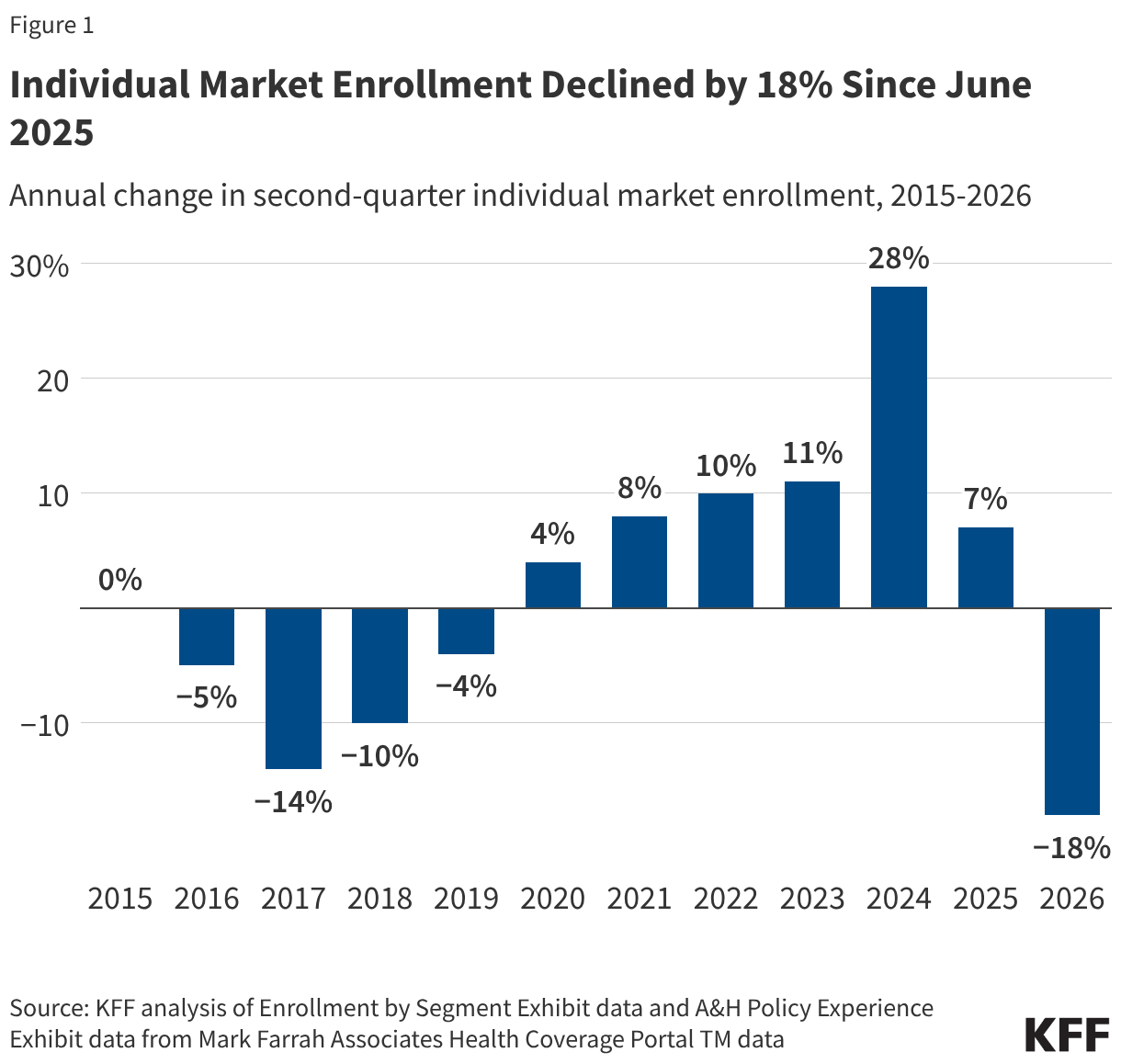
When the Republicans took control of the U.S. Senate and House of Representatives last year, they passed the largest tax cut in history. Six months later, they let the premium subsidies expire on Dec. 31. When that happened, Affordable Care Act premium costs went up, Selena Simmons-Duffin reported for NPR.
“When their costs went up, many of them dropped their coverage,” she wrote, quoting KFF’s Cynthia Cox, a senior vice president and director of KFF’s program on the ACA.
Low-income Americans losing Medicaid
In addition to Obamacare members losing their health insurance, an estimated 5 million low-income Americans have lost their Medicaid coverage this year, as states began implementing new, more stringent work requirements, the Center for Budget and Policy Priorities reported Sept. 29. Medicaid is the federal-state health insurance program for low-income adults and children who cannot qualify for Obamacare.
Under the new work rules, Medicaid members will face more frequent and burdensome requirements in 2027 to remain eligible, the Center explained. In January, the new work requirements will take effect in every state that expanded Medicaid enrollment under the ACA, the Center noted, and as we reported in December.
In August, Nebraska and Montana implemented the new federal work rules early, meaning Medicaid members in Nebraska began losing coverage then, the Center reported. Montana delayed the loss of coverage until Jan. 1, 2027, the researchers noted.
Eight states are exempt from the new work rules because they did not expand Medicaid enrollment under the ACA: Alabama, Florida, Kansas, Mississippi, Tennessee, Texas, South Carolina and Wyoming.
The law began to limit Medicaid eligibility for legal immigrants in October, taking health coverage away from even more people with lawful status, the center added.
Resources
- Uninsured rate rose 37% this year, Merrill Goozner, GOOZNEWS, Oct. 23
- Some conservative states aren’t using Medicaid hardship exemption – for political reasons, Tobi Thomas, The Guardian, Oct. 18, 2026
- Individual Market Enrollment Continues to Fall Through Mid-2026, KFF, Oct. 14, 2026.
- Millions of Medicaid recipients to face draconian requirements as of 1 January, Jessica Glenza, The Guardian, Oct. 13, 2026
- How Does ACA Marketplace Enrollment in 2026 Vary Across Congressional Districts?, KFF, Oct. 8, 2026
- How Has ACA Marketplace Enrollment Changed Across States in 2026?, KFF, July 28, 2026
- States brace for sweeping Medicaid work requirement, Jaymie Baxley, North Carolina Health News for AHCJ, June 17, 2026
- ACA Marketplace Enrollment is Down in 2026—But All of the Data Isn’t in Yet, Feb. 5, 2026
- New Medicaid work rules will challenge enrollees and states, AHCJ, Dec. 19, 2025
- Republicans Call Medicaid Rife With Fraudsters. This Man Sees No Choice but To Break the Rules, Katheryn Houghton, KFF Health News, July 23, 2025
- One man’s story shows the quandary of Medicaid’s benefit cliff, Katheryn Houghton, NPR, July 21, 2025
The post Nearly half of US adults under 65 had little to no health insurance in 2026: Report appeared first on Association of Health Care Journalists.
Information Courtesy By: Joseph Burns, HealthcareNews, Global | Feeds
Almost half (46%) of working-age adults aged 19 to 64 had inadequate health insurance this year, according to a report from The Commonwealth Fund. Published Oct. 22, “The State of Health Insurance Coverage in 2026” was based on the fund’s 2026 Biennial Health Insurance Survey.
Among those adults, 11% were uninsured, 12% had a coverage gap this year, and 23% were underinsured, meaning they had coverage that did not provide access to affordable care, the report showed. Starting last year and continuing now, Affordable Care Act (ACA) marketplace coverage declined, as did enrollment in the individual insurance market, the report noted. Also, Medicaid coverage rates fell, a drop that began after 2022, the report added.
In addition, the report showed a drop in coverage among young adults, 19 to 34, under the ACA and Medicaid and among those the survey classified as low-income working-age adults with a household income under 200% of the federal poverty level. The 200% level equals $31,300 in annual income for an individual and $64,300 for a family of four, the report noted.
‘Really substantial losses’
“The coverage losses that have already happened in the marketplaces are really substantial,” Sara R. Collins, Ph.D., said in a telephone interview. Collins is an economist and senior scholar for the Expanding Coverage and Access and Tracking Health System Performance programs at the Commonwealth Fund.
In the coming months, more Americans will lose their ACA health insurance and millions more are likely to lose their Medicaid coverage this year and next, she said. Among Medicaid members, the coverage losses will be substantial as states implement new work requirements that Congress included in the July 2025 budget reconciliation bill , Collins predicted. For details, see this KFF report: “Tracking Implementation of the 2025 Reconciliation Law: Medicaid Work Requirements.”
“I think we’re going to see major losses as people run up against administrative barriers, and those losses will vary a lot by state,” she said. “Some states that have the resources will put a lot of effort behind trying to keep people enrolled. But other states won’t have as much in terms of resources to keep people covered.”
To put these health insurance losses in perspective, the report noted that enrollment rose after Congress passed the ACA (also called Obamacare) in 2010. “Between 2010 and 2025, the U.S. uninsured rate fell by half, from nearly 16% to 8%, largely as a result of the ACA and expanded premium subsidies for marketplace plans,” The Commonwealth Fund’s Oct. 22 report showed.
37 million could lose health insurance
But the deep cuts in funding for Medicaid and the ACA marketplaces that the Trump administration and Congress made in 2025 will cause even more Americans to lose their health insurance, the report showed. Those changes are expected to drive the number of uninsured people to 37 million by 2036 — about the same rate as in 2014, the report noted.
When the tax credits expired, ACA premium costs rose sharply for many enrollees, particularly those with annual income above 400% of the federal poverty level (FPL) who had become eligible for subsidies under the enhanced credits, KFF reported in May. For a single person, 400% of is annual income of $15,960, and for a family of four, $33,000.
Other Trump administration policy changes also cut enrollment, such as the more than 750,000 enrollees who were ejected from the ACA marketplaces in September. At the time, the federal Centers for Medicare and Medicaid Services announced that it canceled about 315,000 unauthorized enrollments covering more than 760,000 individuals, saving roughly $2.2 billion in taxpayer-funded subsidies, the agency said.
Some of those consumers were not real people, and many were unqualified for premium subsidies, Vice President JD Vance claimed, according to reporting from Margot Sanger-Katz, Sarah Kliff and Christopher Rowland in The New York Times.
Drop in coverage varies by state
Journalists covering this story will find that after the federal government failed to extend the enhanced premium tax credits past 2025, Affordable Care Act members dropped out in every state except New Mexico. The state was an outlier because BeWell, New Mexico’s Affordable Care Act exchange marketplace, enrolled 82,407 residents in health and dental coverage during open enrollment for 2026, state officials announced in June. That 15.4% increase over enrollment last year was the strongest marketplace growth in the nation, BeWell reported.
Outside of New Mexico, however, enrollment varies widely by state and by congressional district, KFF researchers explained in a July report: “How Has ACA Marketplace Enrollment Changed Across States in 2026?”
Last year, a record level of more than 24.3 million Americans were enrolled in Affordable Care Act plans, a fourth consecutive record high that was mostly due to consumers’ use of tax credit subsidies. KFF researchers explained. Congress included the enhanced subsidies in the American Rescue Plan Act, which Democrats in Congress passed during the Biden administration in 2021, KFF reported. Congress extended the tax credits through Dec. 31, 2025, in the Inflation Reduction Act (IRA).
Those subsidies helped to boost ACA enrollment since 2020, rising by 12.9 million from 11.4 million to 24.3 million last year, a 113% increase, KFF noted.
When the Republicans took control of the U.S. Senate and House of Representatives last year, they passed the largest tax cut in history. Six months later, they let the premium subsidies expire on Dec. 31. When that happened, Affordable Care Act premium costs went up, Selena Simmons-Duffin reported for NPR.
“When their costs went up, many of them dropped their coverage,” she wrote, quoting KFF’s Cynthia Cox, a senior vice president and director of KFF’s program on the ACA.
Low-income Americans losing Medicaid
In addition to Obamacare members losing their health insurance, an estimated 5 million low-income Americans have lost their Medicaid coverage this year, as states began implementing new, more stringent work requirements, the Center for Budget and Policy Priorities reported Sept. 29. Medicaid is the federal-state health insurance program for low-income adults and children who cannot qualify for Obamacare.
Under the new work rules, Medicaid members will face more frequent and burdensome requirements in 2027 to remain eligible, the Center explained. In January, the new work requirements will take effect in every state that expanded Medicaid enrollment under the ACA, the Center noted, and as we reported in December.
In August, Nebraska and Montana implemented the new federal work rules early, meaning Medicaid members in Nebraska began losing coverage then, the Center reported. Montana delayed the loss of coverage until Jan. 1, 2027, the researchers noted.
Eight states are exempt from the new work rules because they did not expand Medicaid enrollment under the ACA: Alabama, Florida, Kansas, Mississippi, Tennessee, Texas, South Carolina and Wyoming.
The law began to limit Medicaid eligibility for legal immigrants in October, taking health coverage away from even more people with lawful status, the center added.
Resources
- Uninsured rate rose 37% this year, Merrill Goozner, GOOZNEWS, Oct. 23
- Some conservative states aren’t using Medicaid hardship exemption – for political reasons, Tobi Thomas, The Guardian, Oct. 18, 2026
- Individual Market Enrollment Continues to Fall Through Mid-2026, KFF, Oct. 14, 2026.
- Millions of Medicaid recipients to face draconian requirements as of 1 January, Jessica Glenza, The Guardian, Oct. 13, 2026
- How Does ACA Marketplace Enrollment in 2026 Vary Across Congressional Districts?, KFF, Oct. 8, 2026
- How Has ACA Marketplace Enrollment Changed Across States in 2026?, KFF, July 28, 2026
- States brace for sweeping Medicaid work requirement, Jaymie Baxley, North Carolina Health News for AHCJ, June 17, 2026
- ACA Marketplace Enrollment is Down in 2026—But All of the Data Isn’t in Yet, Feb. 5, 2026
- New Medicaid work rules will challenge enrollees and states, AHCJ, Dec. 19, 2025
- Republicans Call Medicaid Rife With Fraudsters. This Man Sees No Choice but To Break the Rules, Katheryn Houghton, KFF Health News, July 23, 2025
- One man’s story shows the quandary of Medicaid’s benefit cliff, Katheryn Houghton, NPR, July 21, 2025
The post Nearly half of US adults under 65 had little to no health insurance in 2026: Report appeared first on Association of Health Care Journalists.
Click For More Details
2026-11-04 03:38
Except for the headline, this story has not been edited by Healthcare Central is published from a syndicated feed.